

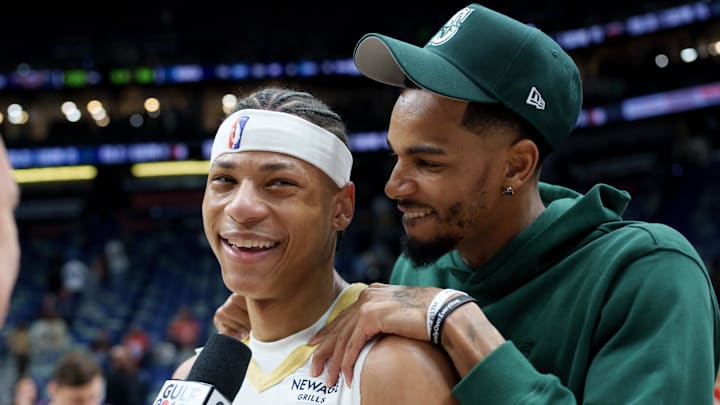
The New Orleans Pelicans have one of the most loaded guard rooms in the entire NBA between Jeremiah Fears, Jordan Poole, and now a healthy Dejounte Murray. For some teams, this amount of talent at one position can lead to competition for touches, drama, and minutes. But for the Pelicans, this is a guard group that has each other's backs, and for a rookie like Fears, who just made the switch from starter to backup, that is extremely valuable.
Following Sunday's loss to the Los Angeles Clippers, Fears was asked about his comfort level making the switch from a starter for 44 games to the team's lead guard off the bench. He gave a ton of credit to both Poole and Murray for helping him ease into a new role.
“Definitely learning, talking to Dejounte, talking to Jordan Poole. Just asking questions, continuing to learn, and they've been giving me some really good advice on the game of basketball, on the court and off the court stuff,” Fears said. “So, just being able to take the pieces of advice they give me and continue to translate them to the court.”
"They’ve been telling me continue to play my game, do what I do in being a point guard on the floor,” said Fears.
The Pelicans have built a perfect environment for Fears to develop
Oftentimes, when rebuilding teams draft young guards, they are thrown into the fire and forced to run an NBA offense from day one. While Fears jumped into that role three games into his career, having the option to move him to the bench and play behind a veteran like Murray is putting him on an excellent development path.
Both guards have completely different styles of play, with Murray being more of a playmaking floor general and Poole being a shot-creating offensive spark plug. But one thing they have in common is that they found ways early in their careers to impact winning. Murray made the All-Defensive Second Team in his second season, and Poole was one of the most important players on a championship-winning team with the Golden State Warriors by his third season. This gives Fears two sources of knowledge and experience that can help mold him into a franchise-level guard.
With Murray, he can learn how to control the tempo of a game, make the right reads in the pick-and-roll, and defend at a high level. Meanwhile, Poole provides insight on how to be a creative shot-creator, space the floor, and bring a spark to a game when the Pels are lacking one. More importantly than these skills, Fears gets to learn what it means to impact winning and build winning habits, something not many young guards have the opportunity to do.
While moving to a bench role may discourage some rookies, Fears has embraced the assignment and used it as an opportunity to grow. With Murray and Poole coaching him up, and with Fears now playing a role that lets him see the game before attacking it, he is on an excellent development plan.
 Add us as a preferred source on Google