

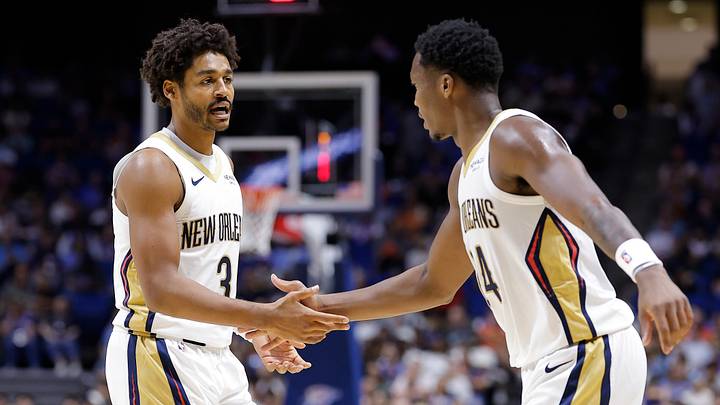
The New Orleans Pelicans’ starting five was a disaster, flat-out disaster: no offensive connectivity, poor defense, and poor spacing. The second unit was the opposite. The five-man unit of Jordan Poole, Jeremiah Fears, Bennedict Mathurin, Saddiq Bey, and Derik Queen was a joy to watch. They pushed the pace well, moved the ball very well, and looked like a much more connected group than the Pelicans' starting unit.
The immediate pushback to these claims is that reserves always play harder in preseason because they are fighting for an opportunity, which I get. But at the same time, I really do think there is something there with this second unit. We see teams all the time try to hang their hat on one specific area of the game and try to beat opponents in it every night. With Jamahl Mosley arriving, the conversation has always been that area is defense, and after one preseason game, I'm not sure how realistic that is.
What could be a real area of strength for this team, if one meaningless preseason game tells us anything, is bench scoring and, in a broader sense, depth.
There's a lot to like about the bench unit
If there is one thing that feels universal about good second units in the NBA, it’s playing fast and getting out and running whenever a fast-break opportunity is there. That’s exactly what the Pelicans' second five did. Whether it was JP pushing the break and attacking the rim, Mathurin gunning a pass ahead to Fears for three, or turning a stop into a quick bucket the other way, it all felt right. Even in the halfcourt, they got into their actions faster, and passes were made with more intent and urgency.
A bigger-picture takeaway: if things don’t work out with Zion Williamson and the older portion of the Pelicans’ core, Mathurin, Fears, Bey, and Queen moving forward is intriguing.
But it wasn’t just that first second unit that looked good; the Pelicans' third group closed out the win in the fourth quarter.
Obviously, not all of those players will be able to have that kind of impact consistently in the NBA, at least not yet. That said, Karlo Matkovic, Trendon Watford, and Bryce McGowens can all be rotational pieces in the league, and they are New Orleans’ 11th, 12th, and 13th men. That level of depth gives Mosley a ton of flexibility, with players who have different skill sets that can help this group match up against so many different teams.
This isn’t a new concept from me by any means, as depth has been the one area I credited this team for all offseason. But it won’t matter if the starters show up the way they did on Tuesday. Yeah, you might win a handful of games because of explosions from your bench, or your starters' lives may be easier if this team finishes in the top five in bench scoring. But the starters still have to set the tone and be able to close games consistently, and I’m not sure if the top-end talent Mosley has to work with is good enough to do that.
Could this be an overreaction and mean nothing a week into the season, when games actually start to matter? Yes. Am I going to stop overreacting after what feels like an eternity since I’ve got to watch Pelicans basketball? No. Stay tuned for more thoughts after Thursday’s game.
 Add us as a preferred source on Google